
41,000. That is the current number of different denominations in the church today. Are you kidding me??? There are that many different issues to disagree about to the point that you say, “Hey, I need to start my own church! I can’t compromise on this!”? I guess we know the answer to Paul’s question in 1 Corinthians 1:13. Christ IS divided. A lot. I searched around and found at least 47 different types of Presbyterian churches in just 1 minute. This isn’t just a Presbyterian issue, but one that is clearly out of control in the body of Christ. My blog is full of posts that have been issues which caused denominations and churches to divide (predestination, Lord’s Supper, baptism, and the Holy Spirit for example). As my 8 year old son recently said on a kayaking trip we took, “Can’t we all just get along?” Sorry son, I think the church is in for a big time out from Jesus.
The state of the church got me to thinking about something Paul says in 1 Corinthians 15:3-4 (you may be wondering if I know any book of the Bible OTHER than 1 Cor., but hey, it has been relevant to our church discussions). “ For I delivered to you as of first importance what I also received: that Christ died for our sins in accordance with the Scriptures, that he was buried, that he was raised on the third day in accordance with the Scriptures…” Paul is saying that in his beliefs in Christianity, there were foundational beliefs/teachings/doctrine that he began with and focused on when introducing Christianity to new believers. This foundation was of course the Gospel of Jesus, His death and resurrection. This all led me to ask, “Did Paul have foundational beliefs that he never allowed compromise, while at the same time having “secondary” beliefs that he could agree to disagree on?
My point is this: the more systematic and detailed our denomination/church’s theology becomes, the more likely it is that we will separate from and refuse to work with other denominations. I am a Bible teacher, so I confess that I can talk for hours the smallest detail of theology (is God in time? are His thoughts sequential? is the subordination of Jesus eternal? what does “begotten” mean anyway? will there be dogs and cats in heaven?) However, the longer I study the Bible, the more I am see the need for concentric circles of beliefs (I am currently working on putting a patent on that name and making millions). What I mean by that is that the middle circle contains beliefs that I have that define whether you ARE a Christian based on the Bible or not. They are not open to compromise, and if you don’t believe them, we can’t work together in the church. Examples in the middle circle would be: salvation by faith, Jesus is God, eternal consequences, etc… (a very dangerous etc… if you ask me, just couldn’t figure out a better ending to that sentence). Click on the images below to make them bigger for a way cool illustration.
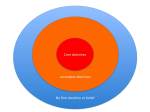

The second circle contains things that I feel sure about, but I could disagree with another Christian on them without questioning their identity as a Christian. Examples would be: details of eschatology, speaking in tongues, or how we do communion. Most of the time, I can disagree on these issues and still work together with these Christians to accomplish the Great Commission.
I have a crazy dream. If we could keep this inner circle to the absolute foundational beliefs, perhaps we could learn to live with diversity within our churches and not need to separate so much. An even crazier dream would be for us to create some kind of new denomination with a generic name like Christian Church. By using truth circles, we could take that number down from 41.000 to say, 11 or something. A global unification of the Christian church; is it possible? Some might see the rise of nondenominational (or interdenominational) churches as a positive sign that we are escaping the “naming” and division of the church. I am not so sure. Often, these nondenominational churches end up developing so much of their own tradition and statements of belief that they may as well be a denomination. They even start their own Bible schools and insist their pastors be trained there.
I count myself as lucky to have had some unique experiences as a Christian. In missions, I have worked with two different organizations that were not attached to one church/denomination, but were a mix of people from many denominations including Methodists, Assemblies of God, Catholic, and so on. We put our differences on the secondary doctrines aside so that we could focus on the blessing of the nations, spread of the Gospel, and mercy ministries to those in need. I noticed that people didn’t even ask one another what church they came from. That ceased to be people’s identity (I am a Methodist, etc…). It showed me that if it is possible in a “parachurch” organization, it should be possible within the church as well.
Unless I am hit on the head really hard, I seriously doubt I will ever be a relativist. I can’t ignore absolute truth so that we can all get along in the church. I am not echoing those voices in the emerging movement who say that truth is unknowable fully, so we should stop “building walls”. The Bible calls them a foundation, not walls, but they still shouldn’t be moved. I can envision a church/denomination though that establishes the unmovable essentials while allowing a diversity of beliefs in secondary ones for the sake of the Gospel and the unity of the body of Christ. Can anyone else out there see that with me?
 The Bible Nerd
Amen, Sean. I was reflecting this week on Paul’s teaching on spiritual gifts in 1 Corinthians and how we have gotten it so wrong. When he introduces the topic in chapters 12 and 13, his whole focus was on unity and love, not the gifts themselves. We tend to focus on the gifts and argue about it.
Dave, it is pretty sad that in a section where he mostly discusses the body and love, with some Holy Spirit and gifts, the church has divided so sharply on its application. I admit I have to watch for pride in my own life, as well as joining the voices of the negative. It is easy to be critical, but not so easy to be part of a solution. Thanks for the comments!
Sean